A Virtual Private Server (VPS) is a hosting environment that provides dedicated server-like resources within a virtualized system. It offers more power, stability, and control than shared hosting, while remaining far more cost-effective than a physical dedicated server.
Modern server virtualization and automation technology makes it possible to run multiple fully isolated VPS instances on a single physical machine, maximizing efficiency and hardware utilization. Each VPS functions like its own independent server, complete with reboot capability, root access, dedicated users, IP addresses, memory, processes, files, applications, and system configurations.
This ensures strong performance, high flexibility, and full isolation—ideal for running business applications, hosting websites, and managing multiple environments reliably and securely.
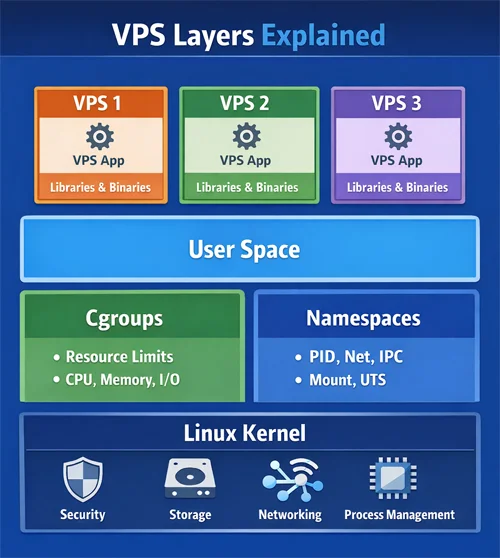
| The operation and management of VPS is identical to stand-alone server |
|---|
| Each VPS has its own processes, users, files and provides full root access. |
| Each VPS can have its own IP addresses, port numbers, tables, filtering and routing rules. |
| Each VPS can have its own system configuration files and can install software and application which will not be affected by other VPS system. |
| Each VPS can have its own versions of system libraries or modify existing ones. |
| For Example: Multiple distributions of Linux can reside on the same physical server. |
| VPS runs off-the-shelf software without any changes. |
| Quality of Service to provide dedicated SLAs for each VPS |
|---|
| Standard: Includes CPU, disk space and network I/O guarantees. |
| Unique: Guarantees on memory - user and kernel, physical and virtual. |
| Unique: Guarantees on disk I/O and many other critical resources (over 20). |
| Virtual Private Servers (VPS) is not a Virtual Machine (VM)! |
|---|
| Runs only the same OS as root OS - Linux on Linux, Windows on Windows |
| 10-100 times better efficiency, dynamic QoS changes for LB and more. |
| The new system (no software is installed) after start up consumes only about 70MB RAM. |